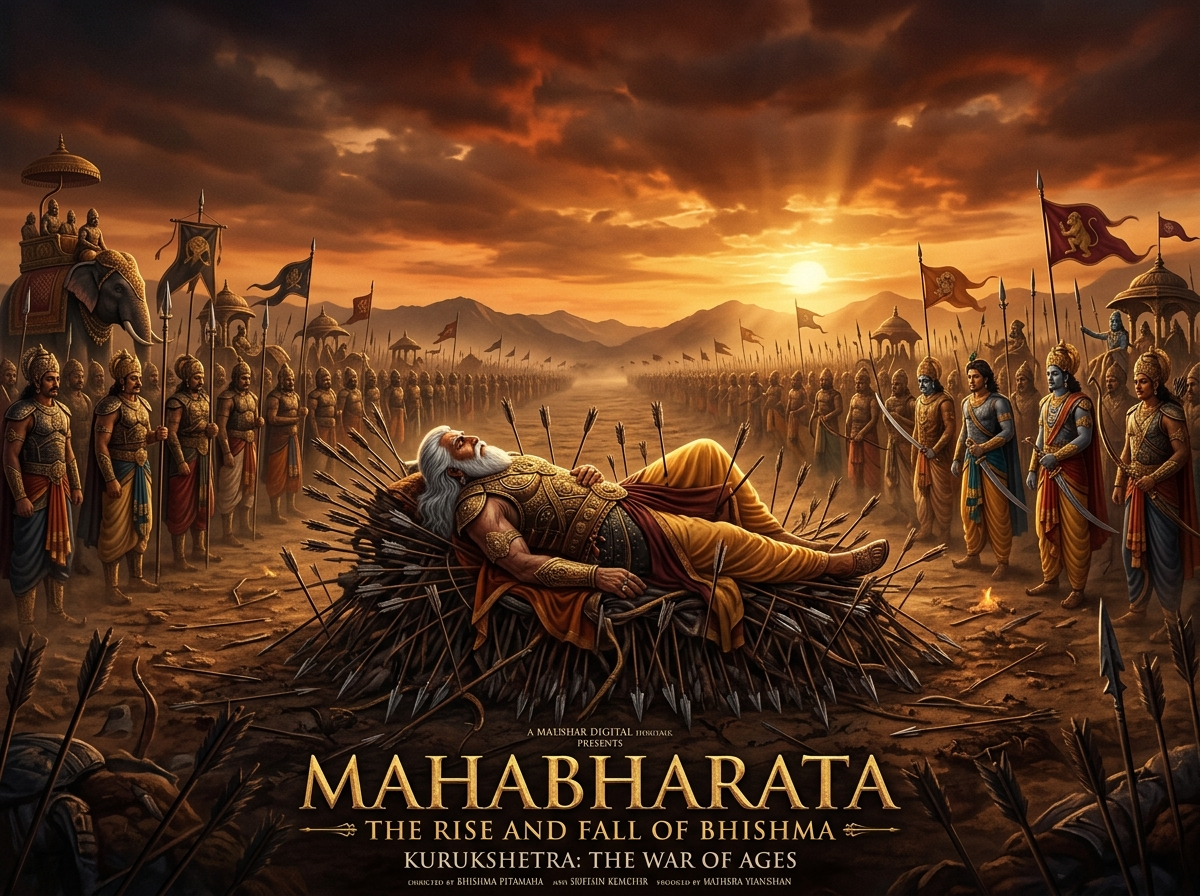
Bhishma
The Grandfather Who Could Not Choose His Side
This is 3067 BCE by traditional reckoning — or roughly the era of the great North Indian kingdoms, whatever the actual date. Bhishma is lying on a bed of arrows on the Kurukshetra battlefield. He chose this. He could have died instantly. Instead he's waiting — holding on for 58 days — because he wants to die on an auspicious date, when the sun turns north.
He has that power. The power to choose when he dies.
It started with a vow. His father Shantanu fell in love with Satyavati, a fisherman's daughter. But her father had conditions: only her sons would inherit the throne. Shantanu already had a son — the boy who would become Bhishma. The boy saw his father's grief and made a vow that re-routed his entire life: he would never take the throne. He would also never marry, never have children, so no future heir could claim he had a stake.
The vow was so severe the gods gave him a gift in return: he would die only when he chose to.
He gave up everything for his father's happiness. Then watched as that choice locked him into serving every king who sat on the Hastinapura throne after — including kings who were not worthy.
Here is the brutal part: Bhishma knew the Pandavas were right. He knew Duryodhana was wrong. He said so, repeatedly, clearly, to Duryodhana's face. He told Karna before the war that he believed the Pandavas would win. He told Dhritarashtra that justice was on the other side.
And then he picked up his bow and fought for the Kauravas anyway.
His reasoning: he ate the salt of Hastinapura. He owed his loyalty to the throne, not to the cause. Duty to an institution, even a corrupt one, over duty to truth.
Krishna — who understood Bhishma better than anyone — didn't just deploy armies against him. He went himself, twice, to try and get Bhishma to switch sides. The moment Bhishma switched, the war would effectively be over. Bhishma refused.
On the tenth day, Arjuna's arrows brought him down. He fell but couldn't touch the ground — the arrows kept him suspended. The armies stopped. Both sides came to pay respects. That's who Bhishma was: the one man everyone on both sides actually revered.
He spent his last 58 days on that arrow-bed dispensing some of the finest governance wisdom in the Mahabharata, preserved in the Shanti Parva. A man who knew exactly what was right, couldn't bring himself to act on it, and then spent his death teaching others how to live it.
The question Bhishma leaves: Is loyalty to an institution ever worth more than loyalty to truth? He died believing it was. We're still arguing about it.