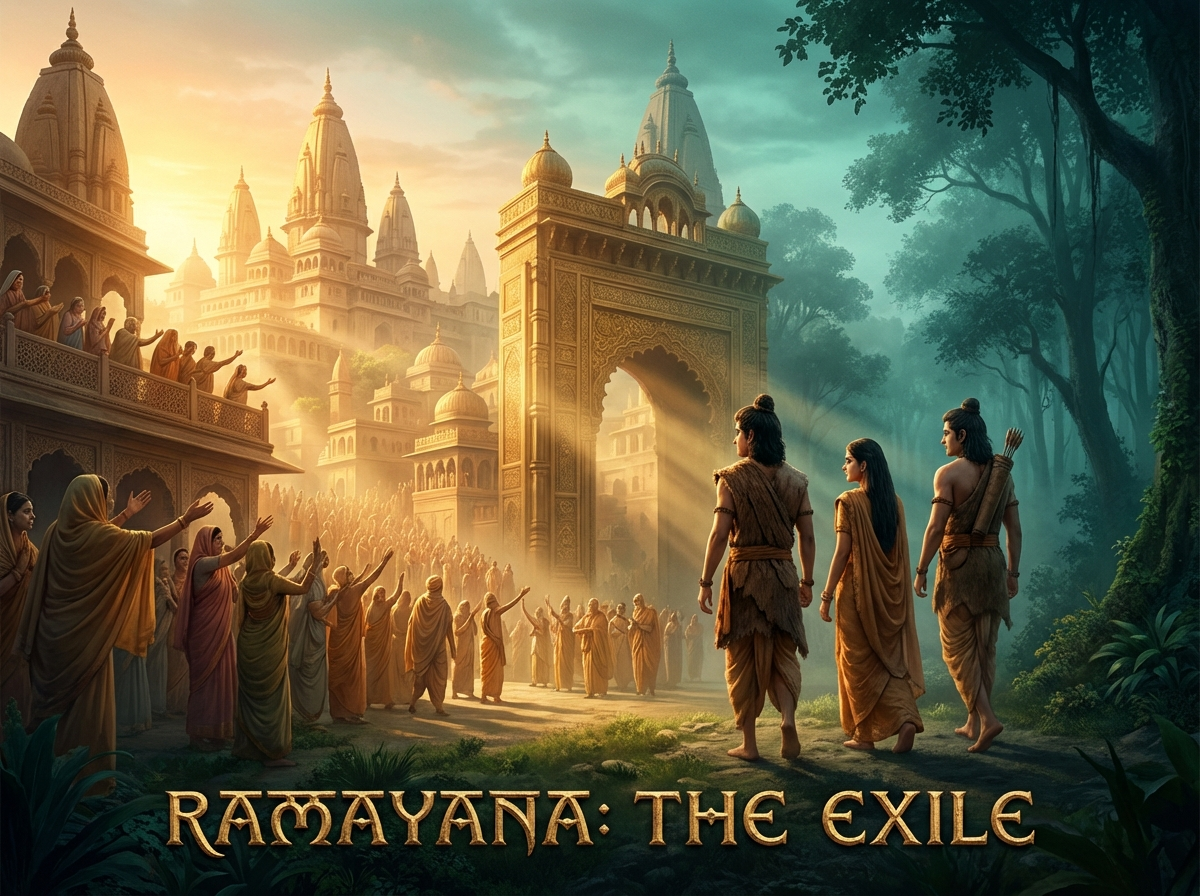
Rama
The King Who Chose Exile Over a Crown
Here's the thing about Rama that most retellings gloss over: he didn't have to go.
It's around 5000 BCE in Ayodhya, if you follow the traditional dating (historians place the text's composition between 7th and 4th century BCE, but the story is set far earlier). King Dasharatha has four sons. Rama is the eldest, the obvious heir, beloved by everyone. The coronation is literally scheduled for tomorrow morning. The city is decorated. The priests are ready. It's done.
Then Kaikeyi — Dasharatha's second wife — invokes two boons the king had promised her years ago on a battlefield when she saved his life. Boon one: exile Rama to the forest for fourteen years. Boon two: crown her son Bharata instead.
Dasharatha collapses. He begs, he weeps, he offers her anything else. The man is literally dying of grief. The entire court is in shock. Bharata himself doesn't want the throne. Lakshmana is ready to take up arms and fight. The people of Ayodhya are ready to revolt.
And Rama says no. To all of it.
Not "no" to the exile. "No" to resisting it. His father gave his word. The word of a king is not negotiable, even when the king himself wants to break it. If Dasharatha's promise means nothing, then what does any promise from the throne of Ayodhya mean? The institution is bigger than the individual sitting in it.
This is what separates Rama from every other mythological hero. Achilles rages. Arjuna hesitates. Odysseus schemes. Rama simply walks into the forest. No anger. No resentment toward Kaikeyi. No bitterness. He changes out of his royal clothes, puts on bark garments, and leaves.
He's twenty-five years old.
What makes this radical is the context. This isn't a monk renouncing the world — it's a warrior prince at the peak of his power choosing dharma over desire. He had every legal, moral, and popular justification to resist. Nobody would have blamed him. His own father didn't want him to go.
But Rama understood something most leaders never learn: authority that breaks its own rules isn't authority. It's just power. And power without dharma is Ravana's game, not his.
Dasharatha dies of grief the night Rama leaves. He never sees his son again. Rama doesn't learn of his father's death until much later, deep in the Dandaka forest. When he does, he performs the funeral rites by a river, alone.
Fourteen years. He served every single day of it.
The hardest kind of strength isn't fighting your enemies. It's honoring a promise that costs you everything — and never once calling it sacrifice.