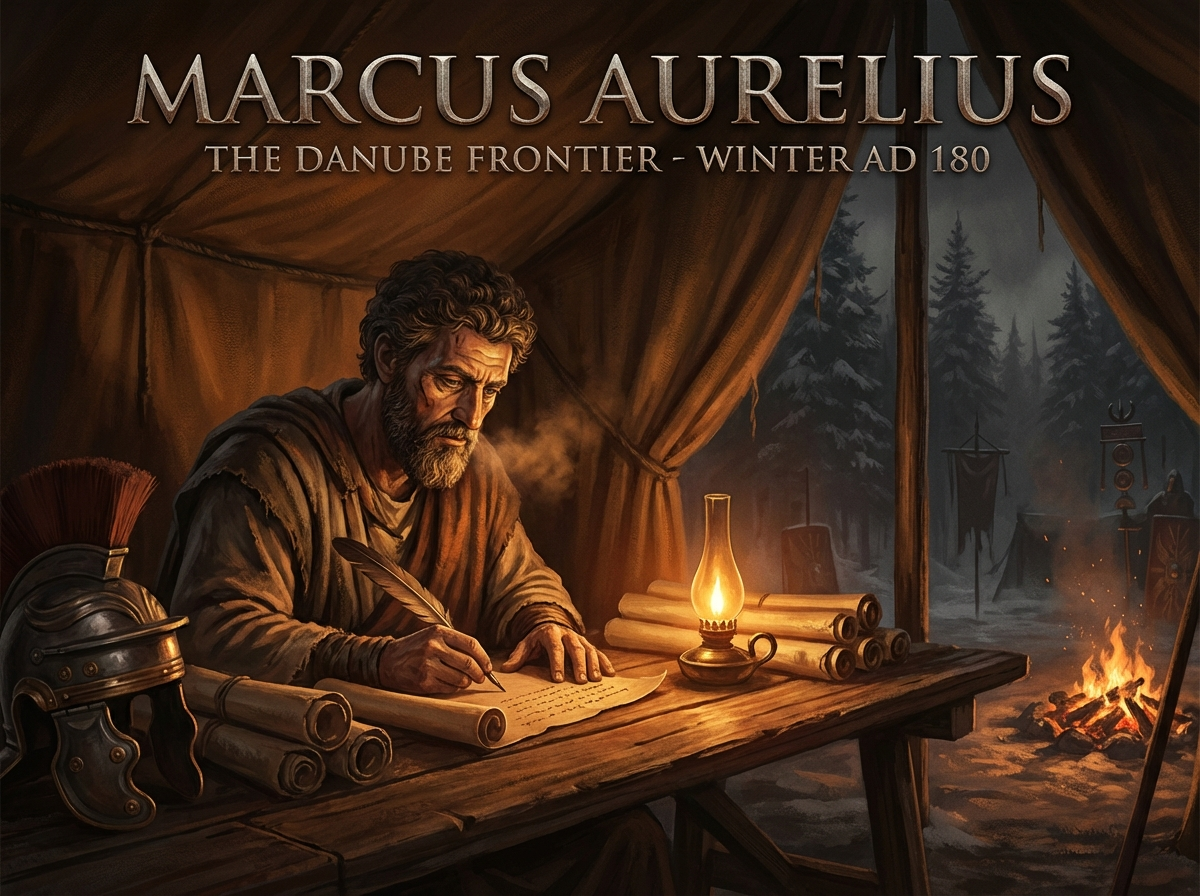
Marcus Aurelius
What Marcus Aurelius Wrote in the Dark
It's 170 CE. The Roman Empire is at its widest stretch — from Scotland to Mesopotamia, from the Rhine to the Sahara. And it's falling apart.
The Antonine Plague has been raging for five years. It came back with the legions from a campaign against Parthia — a respiratory illness that left sores on the skin, possibly smallpox. The co-emperor Lucius Verus died from it in 169 CE. Some estimates put the death toll at 5 million across the empire during its worst years. Military units were wiped out before reaching the battlefield. The grain supply was fracturing.
Meanwhile, the Marcomanni and Quadi — Germanic tribes from north of the Danube — smashed through the frontier. For the first time in 600 years, foreign armies were raiding into Italy itself. Aquileia, less than 100 miles from Rome, was besieged.
Marcus Aurelius was 48. He had never wanted to be emperor. He was a student of Stoic philosophy — trained by the philosopher Rusticus, shaped by the thought of Epictetus. He once described the imperial purple as "nothing but sheep's wool dyed in shellfish blood." He saw power as a burden, not a prize.
And yet he moved north. He stayed on the Danube frontier for most of the next decade, living in camps, managing plague, fighting wars, holding the line. He raised money by auctioning off palace treasures. He organized pestilence relief personally.
And at night, in his tent, he wrote.
Not for publication. Not for history. Private notes, in Greek — reminders to himself:
"You have power over your mind, not outside events. Realize this, and you will find strength."
"The impediment to action advances action. What stands in the way becomes the way."
"Confine yourself to the present."
He never gave these notes a title. We call them the Meditations now. They were found after his death and weren't published for over 1,400 years.
Here's what gets you: these weren't written in a monastery or a library. They were written during one of the most punishing decades in Roman history, by the most powerful man in the world — who clearly didn't feel powerful at all. Every entry is him talking himself back from the edge. From despair. From resentment. From the temptation of just giving in.
He died in 180 CE, still on campaign near Vindobona (modern Vienna). He was 58. The empire he held together started fraying within a generation under his son Commodus.
He didn't know that. He just kept doing the work.
What would you write to yourself if everything was going wrong and no one could see what it was costing you?