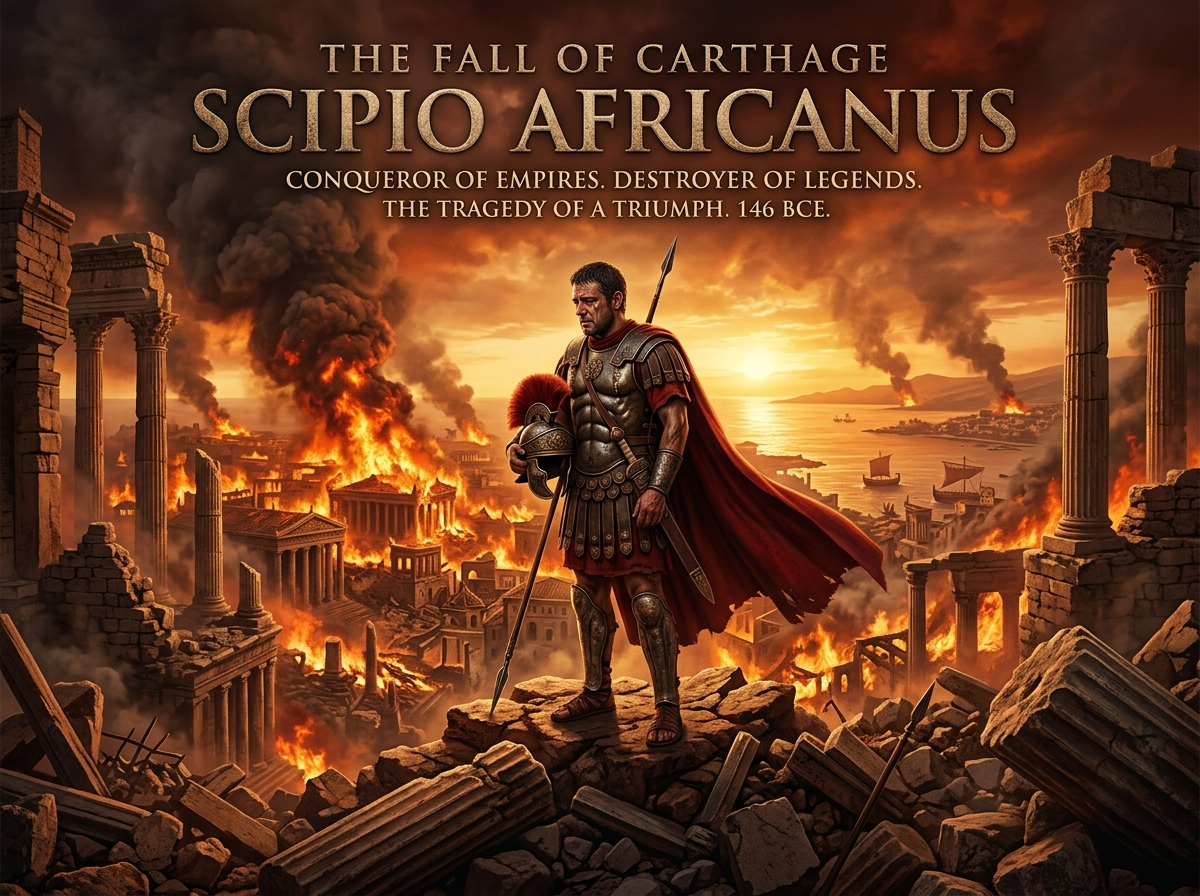
Scipio Aemilianus
The Soldier Who Wept for His Enemy
146 BCE. Scipio Aemilianus stands on a hill overlooking Carthage. The city is burning. After three years of siege and six days of street-by-street fighting, Rome has finally done what it tried to do twice before. Carthage is finished.
Scipio is 39. He's the adopted grandson of Scipio Africanus, the man who beat Hannibal at Zama sixty years earlier. He grew up in the shadow of that legend. Now he's completed the family's unfinished business.
But here's the part they don't put in the triumph paintings. As the flames consume the city, Scipio starts crying. His friend Polybius, the Greek historian, is standing right next to him. Polybius asks what's wrong. You just won. This is Rome's greatest victory.
Scipio quotes Homer. Lines from the fall of Troy. "A day will come when sacred Troy shall perish, and Priam, and his people, shall be slain."
Then he turns to Polybius and says: "This is a great moment. But I have a dread foreboding that someday the same doom will be pronounced on my own country."
Think about that. At the peak of Roman power, at the moment of absolute victory, this general looks at the destruction he caused and sees Rome's own future in it. He understands that empires rise and fall. That what he's doing to Carthage, someone will eventually do to Rome.
He was right. It took another 600 years, but he was right.
Polybius recorded the moment because he knew it mattered. It wasn't weakness. It was the rarest kind of strength: the ability to win completely and still see clearly.
How often do we celebrate a victory without asking what it cost, or what it means that we needed to win that badly in the first place?